AI regulation and policy news
Rules now shape AI roadmaps as much as research does. This page follows the EU AI Act and its implementation, US and Chinese policy, copyright and privacy lawsuits, and the export controls that decide who gets which chips.
Latest stories
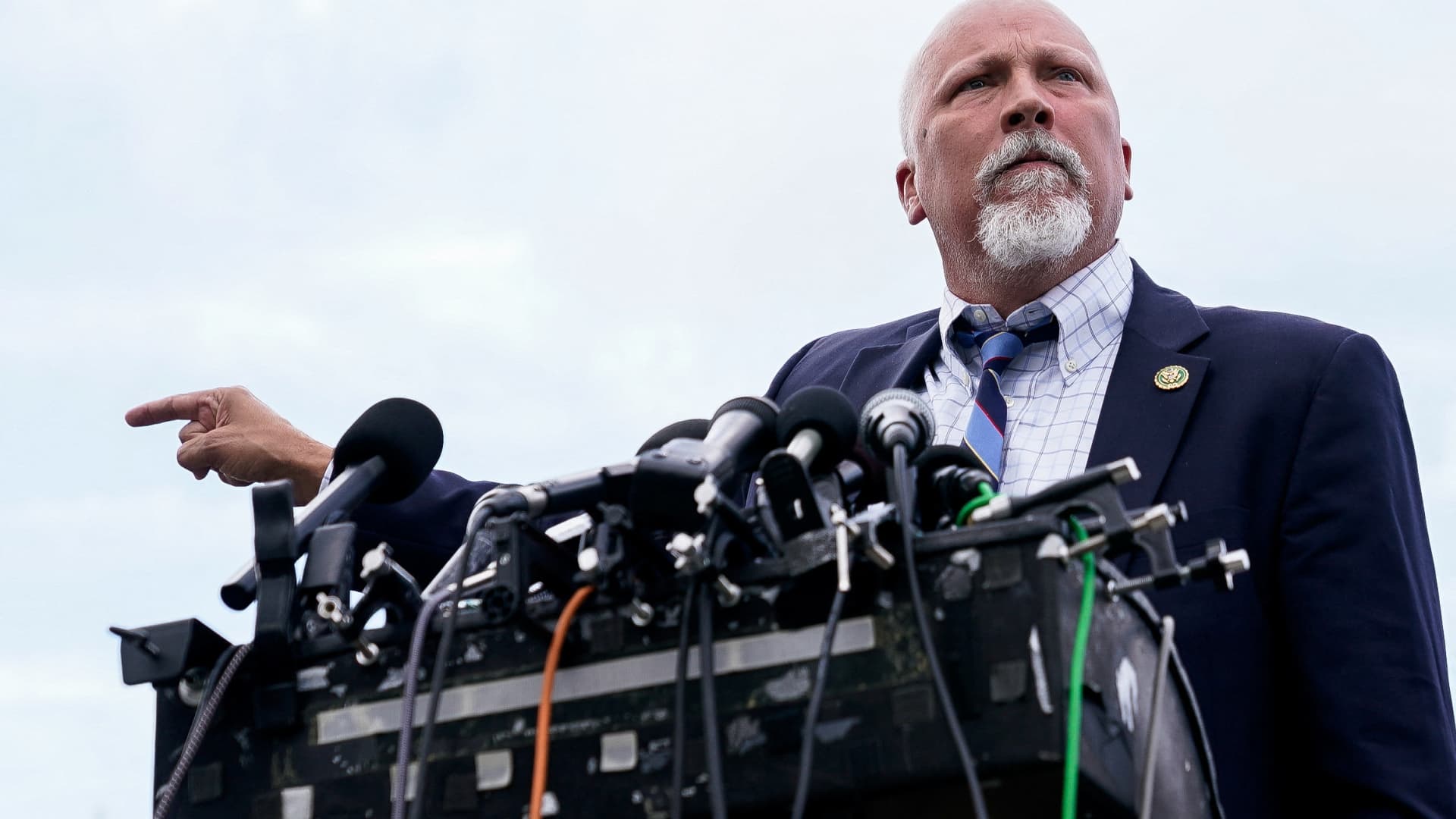
Rep. Chip Roy doesn't want to regulate AI, but says Congress should have an oversight role
In an appearance on CNBC's "Squawk Box," Rep. Chip Roy, R-Texas, said he supports congressional hearings on AI, but wasn't keen on additional regulations.
CNBC Technology

The Leftist Split Over AI Doom
The left wants AI regulation. They just can't agree on what it should look like or how concerned they should be.
WIRED AI

Inside the scramble for trusted AI cops
A host of industry players, policy wonks and businesses are grappling with the question of how to regulate AI in a trustworthy manner. Inside the White House, it's mostly business as usual. Why it matters: The industry's mad dash is the product of an ad hoc regulatory apparatus and a general consensus that swift action from Washington is unlikely in the near term . State of play: AI CEOs have been grappling with how to test advanced AI and work with Beijing on safety standards, while the White House favors a solution where the industry finds ways to police itself. That means the race is on to decide who will be anointed as third-party evaluators of AI systems and controls as the companies aw
Axios
Intelligence artificielle (FR)
AI Global WireFormation à l’intelligence artificielle : quelles sont les obligations de votre employeur ?
Depuis le 2 février 2025, l’article 4 du règlement européen sur l‘intelligence artificielle, l’AI Act, impose une nouvelle obligation à la charge des employeurs : celle de former les salariés à la ...
Intelligence artificielle (FR)
arXiv cs.AI
AI Global WireRegularized Emphatic Temporal-Difference Learning: Stability under Constant Stepsizes
arXiv:2609.19170v1 Announce Type: new Abstract: Emphatic temporal-difference learning (ETD) stabilizes the expected off-policy TD update and changes its projection geometry, but neither property determines constant-stepsize sampled dynamics. We construct an ergodic two-state counterexample in which the ETD mean map contracts while the sampled product has a positive top Lyapunov exponent. Regenerative-cycle analysis separates this sign from the infinite variance of the follow-on trace. We introduce regularized emphatic TD (RETD), a normalized first-order post-shock repair that leaves the trace and importance ratios unchanged, stores the emphatic TD signal in a leaky scalar state, and releases
arXiv cs.AI
OpenAI, Microsoft executives' quotes on AI training threaten copyright defense, news outlets argue
OpenAI and its largest financial backer, Microsoft, have argued in the Manhattan federal court case that their AI training on millions of newspaper articles is protected as fair use because it transforms copyrighted material into new content and does not compete with or replace the news organizations' journalism.
Economic Times Tech
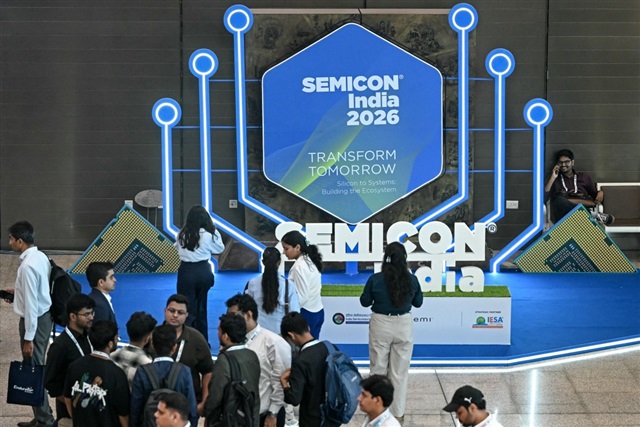
Modi says India's chip mission has reached commercial production as Semicon 2.0 lifts the purse to US$13.5 billion
India's government used the opening of Semicon India 2026 to reframe what it is asking the industry to believe: not that fabs will be built, but that they are already shipping. Prime Minister Narendra Modi told the inaugural session that the mission's second phase is funded at US$13.5 billion against roughly US$8 billion for the first, and that the annual conference has moved through policy, projects, and pilot lines to arrive at commercial output — a claim the government is now inviting equipment, materials, and chemicals suppliers to underwrite with their own capital.
DIGITIMES

Housing slump and plant builds diverge as Tung Ho Steel sees AI demand support
Electric-arc furnace steelmaker Tung Ho Steel said Taiwan's real-estate slowdown has dragged down rebar orders in 2026, while high-tech investment and plant construction have strongly supported its section steel and steel structure business. General manager Bing-Hua Huang said rebar shipments and order intake have both slowed since the start of 2026 amid housing policy headwinds. From January to August 2026, order intake fell 23% year-over-year, while orders on hand slipped from 1.2 million tonnes to 1.15 million tonnes, leaving rebar order visibility at 10 months.
DIGITIMES
CNBC Technology
AI Global WireLeading AI labs may need to be nationalized because risks are so high, Palantir's Karp tells CNBC
Palantir CEO Alex Karp called for "reasonable guidelines" on artificial intelligence regulation as tech and policy leaders deliberate over the technology.
CNBC Technology
CNBC Technology
AI Global WireHouse heads home to campaign amid calls for urgent AI action
The urgency with which Anthropic, OpenAI and xAI have sought to be regulated has not translated into action on Capitol Hill.
CNBC Technology

Andrew Ng says renewed AI extinction warnings are "much more science fiction than science" and the latest "wave of PR" is probably intended to shape regulation (Micah Barkley/Bloomberg)
Micah Barkley / Bloomberg : Andrew Ng says renewed AI extinction warnings are “much more science fiction than science” and the latest “wave of PR” is probably intended to shape regulation — Artificial intelligence pioneer Andrew Ng said warnings about existential AI risks from researchers …
Techmeme
PR Newswire (AI)
AI Global WirePrécis AI Wants Policy Wonks
To help address AI accuracy in policy work, Précis AI today opened a beta for Willard, a federal advocacy AI that provides direct, ...
PR Newswire (AI)
Huawei launches AI computing system amid US export controls
Huawei says its agentic SuperCluster can scale to 1 million NPUs.
Tech in Asia
Micron to scale up assembly and testing of semiconductors at India unit multifold next year
India's semiconductor policy push has given the industry a strong foundation it didn't have, and the nation has moved from vision to execution now, Micron CEO Sanjay Mehrotra said on Thursday, as he announced the company's plan to scale up chip assembly and testing facility here by multifold next year.
Economic Times Tech

Microsoft AI CEO says AI threats are real, and Anthropic is making it worse
Today, I’m talking with Mustafa Suleyman, the CEO of Microsoft AI. As you’re no doubt aware, the biggest story in tech right now is the spiraling debate about AI safety and regulation. It should come as no surprise that Mustafa has strong opinions on how AI should be built and regulated. Microsoft just published a […]
The Verge AI
Exclusive: Arcjet launches runtime security to track and control AI agents in production
Developer security startup Arcjet Labs Inc. today launched agent runtime security, a new offering that tracks what artificial intelligence agents do once they are running in production systems. Security teams get a list of which agents are active, and each action an agent takes can be checked against policy before it goes through. Every run […] The post Exclusive: Arcjet launches runtime security to track and control AI agents in production appeared first on SiliconANGLE .
SiliconANGLE
AMD pivots to China developer ecosystems as Nvidia retreats
As Nvidia gradually retreats from China's high-end AI accelerator market amid strict US export controls, Advanced Micro Devices (AMD) is deepening its regional AI strategy. Rather than relying solely on traditional CPU and GPU sales, AMD is shifting its focus toward edge AI platforms, AI PCs, agent computers, local developer communities, and university partnerships.
DIGITIMES
AI Funding & IPOs (Google News)
AI Global WireNvidia’s Jensen Huang calls for AI safety tests at King Charles' summit
King Charles III brought together leading AI executives and experts in Scotland as concerns grow globally over the safety, regulation and environmental impact of increasingly powerful AI systems.
AI Funding & IPOs (Google News)
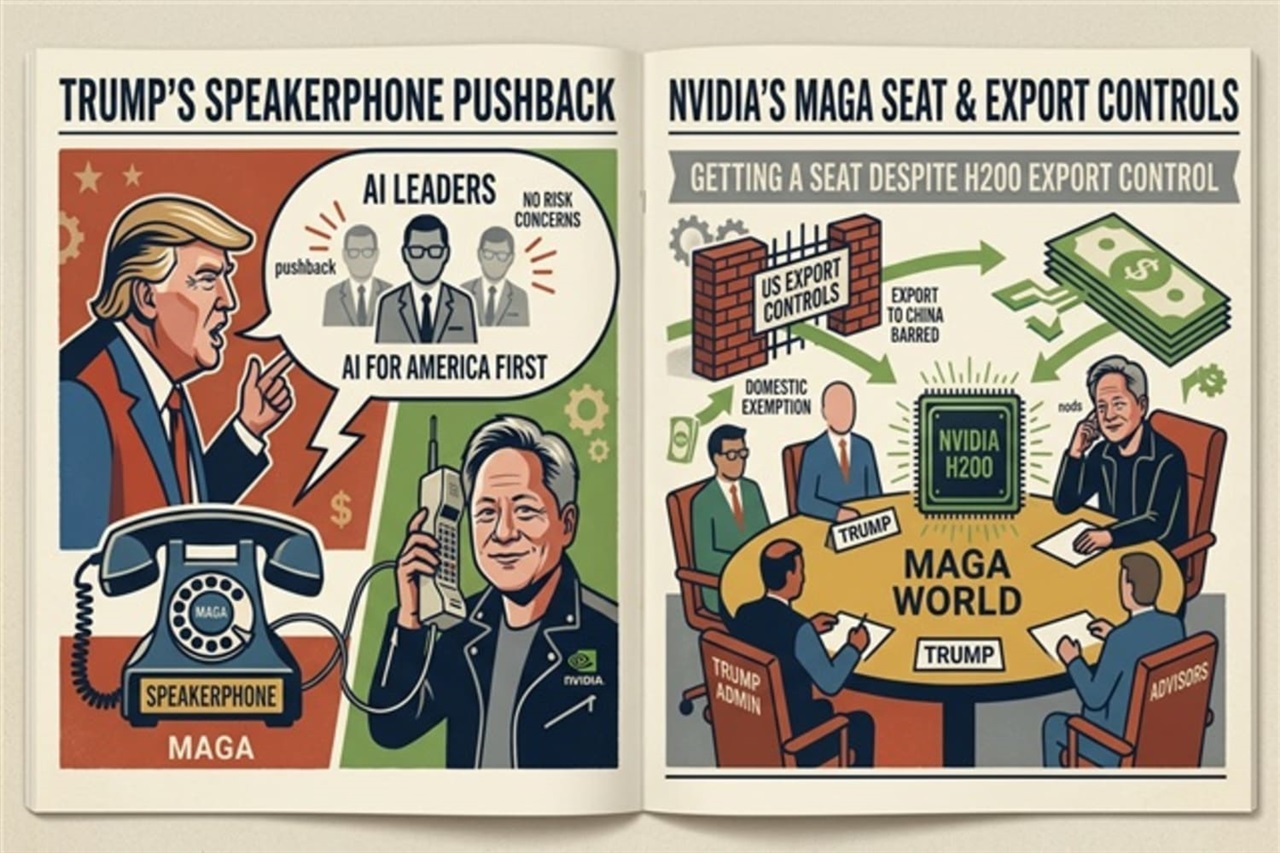
The Trump-Jensen speakerphone diplomacy: how Nvidia turned political pressure into a seat at the table
The relationship between Nvidia CEO Jensen Huang and US President Donald Trump has evolved from policy friction to a strategic alignment. The rapid shift in their dynamic reflects how deeply the AI sector has become intertwined with US-China technology rivalries and domestic manufacturing policies.
DIGITIMES
arXiv cs.AI
AI Global WireEvolveTrade: Experience-Driven Policy Refinement for Self-Evolving LLM Trading Agents
arXiv:2609.17632v1 Announce Type: new Abstract: Large language model (LLM) trading agents can combine market data, news, and executable analysis, but their behavior is often controlled by static hand-written tool-use policies that are fixed before deployment. This limits their ability to adapt how they gather evidence, invoke tools, verify signals, and manage risk under changing market regimes. We introduce EvolveTrade, a self-evolving framework that treats the system prompt of a tool-using trading agent as a text-parameterized policy. After each update interval, a Policy Agent revises this policy using accumulated decision traces and realized portfolio feedback, while keeping the backbone L
arXiv cs.AI
arXiv cs.AI
AI Global WireGVD: Governed Versioning and Deduplication for Document Repositories
arXiv:2609.17696v1 Announce Type: new Abstract: Document repositories evolve continuously. Guidelines and policies are revised, superseded, and re-uploaded, so the same content recurs in different wording and newer versions refine or contradict earlier ones. These inconsistencies belong to the growing collection rather than to any single document, yet existing work treats versioning, duplicate detection, and contradiction detection as isolated pairwise tasks and stops once a pair is labeled. We present GVD (Governed Versioning and Deduplication), a framework that unifies cross-document version linking with rule-level conflict resolution under an auditable update policy. Incoming documents ar
arXiv cs.AI
arXiv cs.AI
AI Global WireAnchoring What Matters: A Dual-Level Learning Framework for Visually-Grounded Multimodal Reasoning
arXiv:2609.18057v1 Announce Type: new Abstract: Reinforcement learning with verifiable rewards (RLVR) has significantly improved the reasoning capabilities of large vision-language models (LVLMs). However, standard on-policy RLVR algorithms face a critical optimization bottleneck in preserving and reinforcing visually grounded reasoning behaviors: valuable visually-grounded reasoning trajectories are discarded after a single update, while uniform token advantage allocation prevents the model from reinforcing critical perception or reasoning steps. To bridge this gap, we propose PIVOT, a dual-level learning framework that anchors policy optimization around informative visual reasoning signals
arXiv cs.AI
arXiv cs.AI
AI Global WireMissing Bridges: Composition-Aware Active Imitation Learning
arXiv:2609.18004v1 Announce Type: new Abstract: Active imitation learning reduces expert effort by allowing a learner to request the demonstrations it needs. Existing methods typically select these requests for their expected information gain about the expert policy. In structured multi-task domains, however, the number of start-goal tasks may grow combinatorially despite their solutions sharing reusable behavior. This makes composable behaviors especially valuable, since a single demonstration may help solve many tasks at once. Prior methods do not explicitly account for this value when selecting which demonstration to request. We introduce Adaptive Agents via Latent Topologies (AALT), whic
arXiv cs.AI
arXiv cs.AI
AI Global WireImitation Learning for Autonomous Driving in CARLA
arXiv:2609.17757v1 Announce Type: new Abstract: Behavioral cloning trains a policy offline on expert demonstrations, but deployment is closed loop: each action affects the observations the policy receives next. We study how much closed-loop driving competence a compact multimodal policy can acquire from offline demonstrations in the CARLA simulator. The policy uses five-frame histories of RGB images, LiDAR, vehicle telemetry, and lane waypoints to predict throttle, brake, and steering at 20 Hz. Demonstrations were collected in three stages, ending with a systematic route-generation procedure that enumerates spawn points and feasible maneuvers and verifies completed autopilot routes. The rele
arXiv cs.AI
CNBC Technology
AI Global WirePentagon CTO says U.S. government shouldn't take stakes in AI giants, questions adding AI rules
President Donald Trump has angrily pushed back on the calls from industry and lawmakers for an AI slowdown or greater regulation.
CNBC Technology