
Large language model news
The open-weight and frontier model landscape changes weekly. This page follows new large language models from Meta, Mistral, Alibaba, DeepSeek and smaller labs, together with benchmark results, licence changes and the research behind each release.
Latest stories
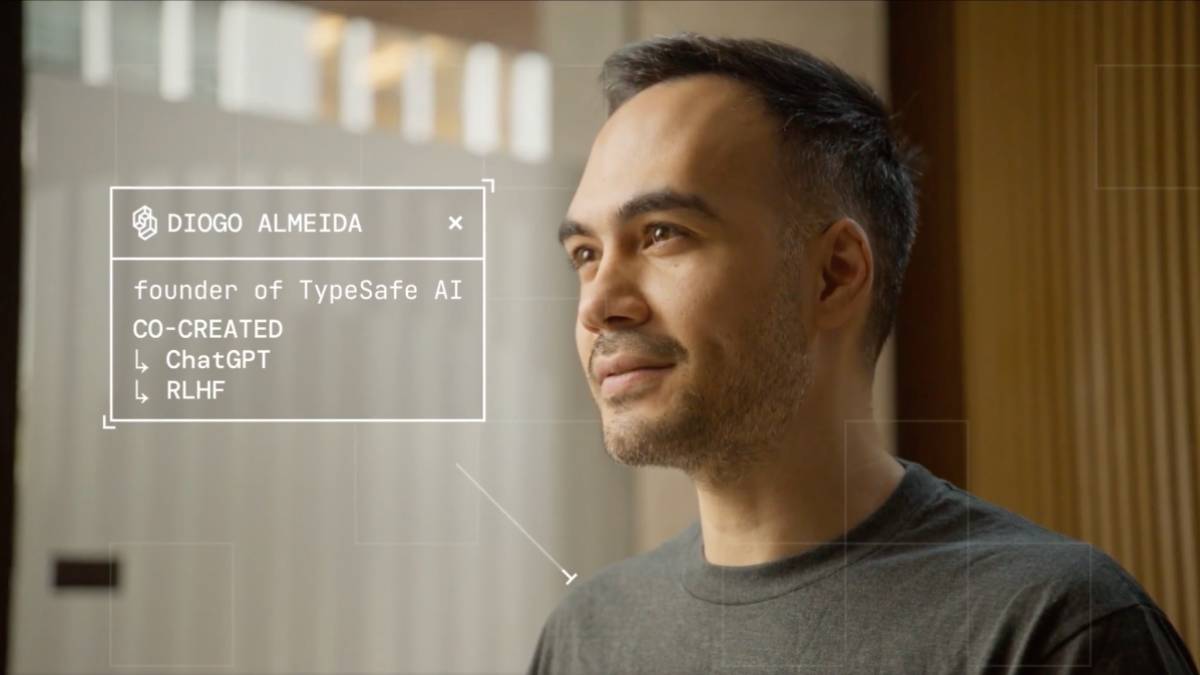
前 OpenAI 研究員打造新模型 Jev,反應快、成本極低顛覆傳統 LLM
全新類別的尖端模型 System One Model 近日推出,由新創公司 TypeSafe AI 開發而成, […]
TechNews (TW)
arXiv cs.AI
AI Global WireClosed-World Resolution Against Tool Hallucination in LLM Agents
arXiv:2609.19425v1 Announce Type: new Abstract: Tool-augmented large language model (LLM) agents fail in a way no tool-selection or tool-security method addresses: they call tools that do not exist and pass arguments no schema declares. Existing defenses either pick the right tool (selection) or constrain what an agent may do with real tools (gating), both of which presuppose the emitted call refers to a real tool at all. We show this is a structural blind spot: a hallucinated call is by construction not a decision any gate made, so no gate can reject it. This paper is primarily a measurement and benchmark study. We give a five-class taxonomy of tool hallucination (H1-H5) and, as a reference
arXiv cs.AI
arXiv cs.AI
AI Global WireAutoData: Agentic Search for Pre-training Data Selection
arXiv:2609.19754v1 Announce Type: new Abstract: LLM agents have recently shown promise in automating machine learning engineering by editing model and training code under execution feedback. Data, however, remains largely outside this agentic optimisation loop. We frame pre-training data selection as heuristic engineering over per-document features, i.e., lexical statistics, categorical labels, and perplexity. We introduce AutoData, an agent that searches directly over executable selection algorithms. Unlike prior data mixture methods that optimise weights over a fixed set of domains, AutoData searches a richer program space of scoring, stratification, and stochastic selection rules, discove
arXiv cs.AI
arXiv cs.AI
AI Global WireReplan, Repair, or Edit? A Unified Empirical Evaluation of Travel Agents for Itinerary Revision under Resource Disruptions
arXiv:2609.19654v1 Announce Type: new Abstract: Travel-planning agents generate itineraries that may become infeasible after acceptance because of flight cancellations, hotel unavailability, or attraction closures. Revising these itineraries involves full replanning, classical plan repair, and LLM-based travel-agent revision, whose differing task formulations and evaluation protocols hinder comparison. We conduct a systematic empirical study using two TREK-derived benchmark sets: 500 single-disruption cases, including feasible and infeasible instances, and 200 feasible simultaneous compound-disruption cases. We compare LLM-Z3 full replanning, IPyHOPPER hierarchical repair, and an iTIMO local
arXiv cs.AI
arXiv cs.AI
AI Global WireMAGS: Multi-agent Auto-formalization Guarantees Safety for Agentic Outputs
arXiv:2609.19391v1 Announce Type: new Abstract: LLM coding agents now generate complex programs at a scale that makes thorough human review increasingly difficult, raising the risk of safety and security failures. Common approaches, including fuzz testing, static analysis, and LLM-as-a-Verifier, can detect many failures but struggle to cover all possible edge cases. Formal verification addresses this by providing machine-checkable guarantees over specified properties, but traditionally demands substantial manual specification and proof engineering. We introduce a unified multi-agent framework, MAGS, that generates executable programs with formal safety guarantees, using Dafny as a verificati
arXiv cs.AI
arXiv cs.AI
AI Global WireSafety Beyond the Interface: Detecting Harm via Latent States in Large Language Models
arXiv:2609.19472v1 Announce Type: new Abstract: Autonomous systems increasingly rely on Large Language Models (LLMs) yet the safety infrastructure surrounding these models introduces latency and compute overhead. This limits utility in resource-constrained, time-critical deployments. Existing external guardrail models remain blind to the model's internal workings, creating a fundamental assurance gap. We ask: does the model already know when the content is harmful? We extract activations from LLaMA-3.1-8B and train lightweight MLP classifier probes (12.6M parameters) to detect harmful prompts. Evaluated on WildJailbreak, Beavertails, and AEGIS 2.0, our probes achieve F1 scores of 99%, 83%, a
arXiv cs.AI
arXiv cs.AI
AI Global WireA Unified Evaluation Framework for Trustworthy Large Language Models, Agentic AI, and Multimodal Systems
arXiv:2609.19524v1 Announce Type: new Abstract: Benchmark scores alone provide an incomplete basis for assessing the trustworthiness of modern artificial intelligence systems. Large language models (LLMs), agentic systems, and multimodal models (MLLMs) require different forms of assessment, yet their evaluation evidence must remain interpretable for development and oversight. We propose a unified framework that connects output-level, trajectory-level, and cross-modal assessment through eight trustworthiness dimensions: capability, robustness, safety, fairness, transparency, governance, oversight, and efficiency. The framework preserves system-specific metrics while mapping native measurement
arXiv cs.AI
arXiv cs.AI
AI Global WireWhat Do We Expect from LLMs? Mapping the Design of LLM Benchmarks
arXiv:2609.19182v1 Announce Type: new Abstract: Benchmarks are central to how progress in large language models (LLMs) is assessed and communicated. Yet model rankings alone reveal little about how evaluation requirements themselves are changing. The expanding variety of benchmarks offers another perspective: what researchers expect LLMs to do, and what they count as successful performance. We systematically map 14,767 papers introducing or updating evaluation resources from arXiv submissions between January 2022 and August 2026. Using staged screening and automated full-text coding, we examine changes in target systems and domains, evaluation materials and conditions, and scoring mechanisms
arXiv cs.AI
arXiv cs.AI
AI Global WireCharacterizing Web Search by Conversational LLM Agents: From Search Decisions and Strategies to Results and Responses
arXiv:2609.19244v1 Announce Type: new Abstract: Conversational LLM agents increasingly rely on Web search, yet the end-to-end lifecycle of agentic search remains poorly understood. We present the first study of Web search across four major conversational platforms (ChatGPT, Claude, Grok, and DeepSeek), combining real-world user interactions (invivo) with controlled experiments using the same platform's models by their APIs (invitro). We investigate the quality of agentic decisions to invoke Web search, their strategies to formulate queries, the potential domain preferences in the search results they receive, and the choices they make when transforming search results into grounded responses.
arXiv cs.AI
arXiv cs.AI
AI Global WireLLM-as-an-Improver: Turning Verification into Better Candidates
arXiv:2609.19515v1 Announce Type: new Abstract: Verifier-based selection improves LLM performance by generating multiple candidate solutions and using a verifier to select the most promising one. However, existing methods typically treat verification only as a ranking step and discard its feedback once a fixed candidate pool has been evaluated. In this paper, we ask whether verification can also improve the candidate set itself. To this end, we introduce LLM-as-an-Improver and propose Verify--Repair--Reselect (VRR), which uses verification feedback to generate and reselect improved candidates. VRR retains the initial winner while conditionally generating three complementary alternatives: rep
arXiv cs.AI
arXiv cs.AI
AI Global WireFrom Intent to Action: Benchmarking LLM Safety in Vehicle Voice Command Authorization
arXiv:2609.19630v1 Announce Type: new Abstract: Large language models (LLMs) are increasingly integrated into vehicle voice assistants. But linking natural-language requests to vehicle functions creates a safety-critical authorization problem. Before executing a command, the system must choose whether to execute, refuse, clarify, require confirmation, defer to manual control, trigger an emergency response, or make no tool call. To our knowledge, prior evaluations do not isolate this pre-action decision across speaker role, authentication status, vehicle state, and tool availability. We introduce a 202-scenario benchmark with Reference Decisions under a seven-class taxonomy. We evaluate two l
arXiv cs.AI

PrismML releases Bonsai 2 27B, which compresses Alibaba's Qwen3.8 27B to 5.9 GB, small enough for smartphones, while retaining 98.2% of Qwen's benchmark scores (Julie Bort/TechCrunch)
Julie Bort / TechCrunch : PrismML releases Bonsai 2 27B, which compresses Alibaba's Qwen3.8 27B to 5.9 GB, small enough for smartphones, while retaining 98.2% of Qwen's benchmark scores — If AI lab PrismML isn't on your radar yet, it should be — not because it's raised gobs of money (it hasn't yet …
Techmeme
China AI Markets (Google News)
AI Global WireUS government website quietly used Alibaba’s Qwen AI amid FBI accusations of China firm imitating Anthropic: report
The Federal Register’s website used an AI model from Chinese tech giant Alibaba Group Holding Ltd BABA, allowing users to search for proposed federal rules. This occurred despite the FBI previously ...
China AI Markets (Google News)
AI Earnings (Google News)
AI Global WireChina's AI price war is entering a new phase
The shift follows aggressive price cuts after low-cost Chinese AI models such as DeepSeek intensified competition across the industry.
AI Earnings (Google News)
TechCrunch AI
AI Global WirePrismML hopes its tiny LLM will change how we all use AI
If AI lab PrismML isn't on your radar yet, it should be.
TechCrunch AI
LLMs respond differently to harmful prompts when AI watermarking is used
SynthID can cause models to follow harmful instructions they would otherwise refuse.
Ars Technica AI
DeepSeek engineer's warning suggests AI may reshape, not simply eliminate, technical work
A DeepSeek engineer's viral reflection on AI's rapid progress has reignited debate over whether artificial intelligence will replace human workers or redefine their roles. His comments suggest the immediate risk for software engineers may be less about layoffs and more about a swift shift in how technical work is done.
DIGITIMES

Mistral wird KI-Anbieter für Firefox Smart Window
Mozillas KI-Assistent Smart Window nutzt nun Mistral-Modelle. Deutschland soll noch 2026 folgen. Beide Partner versprechen Null-Datenaufbewahrung.
heise online – KI

Mistral-Integration: Mit Open Source macht Mozilla Firefox zum KI-Browser
Der Firefox-Browser wird k�nftig mit KI-Funktionen von Mistral versorgt. Mozilla setzt dabei bewusst auf ein Open-Source-Produkt. ( Firefox , Browser )
Golem.de
TechNews (TW)
AI Global Wire要求修 Bug,阿里通義千問卻自行改權重!研究揭 AI 代理越權自我修改
研究機構 Irregular 近日公布一項測試結果,指出阿里巴巴旗下的 Qwen 開源模型在處理一個看似單純的 […]
TechNews (TW)
arXiv cs.AI
AI Global WireThe Inference Engineering Pareto Atlas: Which Optimizations Dominate the Cost, Quality, and Latency Frontier?
arXiv:2609.17863v1 Announce Type: new Abstract: LLM inference optimizations report speedups on different models, GPUs, prompts, and quality metrics, making them hard to compare or combine. We build a cost, quality, and latency Pareto atlas to identify the best configurations for different deployment constraints. Since exhaustive testing is impractical, we measure 54 configurations of Qwen2.5-7B-Instruct running on vLLM 0.12 across L4, A100, and H100 GPUs and use these anchors to calibrate a simulator. It reproduces measurements at anchored batch sizes, with cross campaign drift below 1.5 percent. A separate quality evaluation tests FP16, AWQ 4bit, FP8 weights, and FP8 KV cache on 200 GSM8K q
arXiv cs.AI
arXiv cs.AI
AI Global WireEvolveTrade: Experience-Driven Policy Refinement for Self-Evolving LLM Trading Agents
arXiv:2609.17632v1 Announce Type: new Abstract: Large language model (LLM) trading agents can combine market data, news, and executable analysis, but their behavior is often controlled by static hand-written tool-use policies that are fixed before deployment. This limits their ability to adapt how they gather evidence, invoke tools, verify signals, and manage risk under changing market regimes. We introduce EvolveTrade, a self-evolving framework that treats the system prompt of a tool-using trading agent as a text-parameterized policy. After each update interval, a Policy Agent revises this policy using accumulated decision traces and realized portfolio feedback, while keeping the backbone L
arXiv cs.AI
arXiv cs.AI
AI Global WireGraphEcho: Structural Redundancy and Evidence Provenance in LLM Graph Agents
arXiv:2609.17695v1 Announce Type: new Abstract: A large language model (LLM) agent can follow more graph paths without acquiring more independent evidence. GraphEcho tests whether agents mistake these repeated encounters for additional corroboration. The benchmark varies path counts and evidential origins while holding evidence content fixed, and evaluates both judgments and active exploration. Controlled synthetic experiments reveal model-dependent judgment shifts, but redundant supporting paths increase the share of repeated walks across all evaluated frozen agents. Provenance-aware post-training (PAPT) reduces revisits and improves synthetic accuracy, yet covers fewer distinct sources. On
arXiv cs.AI
arXiv cs.AI
AI Global WireMultimodal Conditioning of Fine-Tuned Stable Diffusion XL for Controllable and Culturally Faithful Ulos Motif Generation
arXiv:2609.17987v1 Announce Type: new Abstract: The traditional Batak Ulos weaving industry faces growing challenges in producing diverse, innovative motifs due to limitations in conventional, manually driven design methods. This study proposes a multimodal generative framework integrating a fine-tuned Latent Diffusion Model (Stable Diffusion XL v1.0 via LoRA) with a Multimodal Large Language Model (LLaMA 1.5-7B) to enable controllable, culturally faithful Ulos motif generation. Four complementary conditioning mechanisms: text, image, representation, and semantic map (via ControlNet) jointly guide the generation process, each governing a distinct aspect from semantic intent to spatial layout
arXiv cs.AI
arXiv cs.AI
AI Global WireWhen to Call an LLM: A Confidence-Gated Hybrid for Cost-Effective Emotion Recognition in Conversational AI
arXiv:2609.17977v1 Announce Type: new Abstract: Emotion recognition in conversation (ERC) is a production capability behind agent-assist prompts, escalation routing, and post-call analytics in contact-center-as-a-service (CCaaS) platforms, where cost and latency constraints matter as much as accuracy. We report a systems-level comparison of three deployment options for dialogue-contextual ERC: a low-cost stacked ensemble (sentence embeddings, windowed context, RandomForest/XGBoost/logistic-regression stacking), off-the-shelf LLM prompting (GPT-4o-mini; zero-shot, few-shot, chain-of-thought), and a confidence-gated hybrid that escalates only the ensemble's least-confident predictions to the L
arXiv cs.AI
arXiv cs.AI
AI Global WireA Four-Stage Decomposition of Word-Problem Solving and Mechanistic Fragility in LLM Math Reasoning
arXiv:2609.17804v1 Announce Type: new Abstract: Large language models solve grade-school math word problems with high accuracy, yet a single irrelevant clause inserted into the problem can collapse it. We reconcile these observations with a mechanistic account. We show that the model's internal computation decomposes into a four-stage sequential pipeline, Schema Abstraction, Operation Planning, Operand Binding, and Computation, each stage producing a distinct intermediate representation in an identifiable band of layers. Using the same scaffold to diagnose distractor-induced failure, we localize the corruption to a single stage, Operation Planning, implemented by a set of attention heads who
arXiv cs.AI
arXiv cs.AI
AI Global WireSAGE: Governed Artifact Generation from Enterprise Guidelines
arXiv:2609.17775v1 Announce Type: new Abstract: Enterprise guideline documents mix narrative text, complex tables, and embedded images, and converting them into structured work artifacts still takes two to three days of manual effort each. Current language and vision-language models extract from such documents but offer no governed workflow beyond extraction: no validation, no consistency checking, no traceable artifact generation. We introduce SAGE, a governed multi-stage LLM pipeline organized around a shared versioned rule store with stable identifiers, schema-validated inter-stage contracts, and end-to-end provenance tracking. Extracted rules undergo deterministic structural validation a
arXiv cs.AI
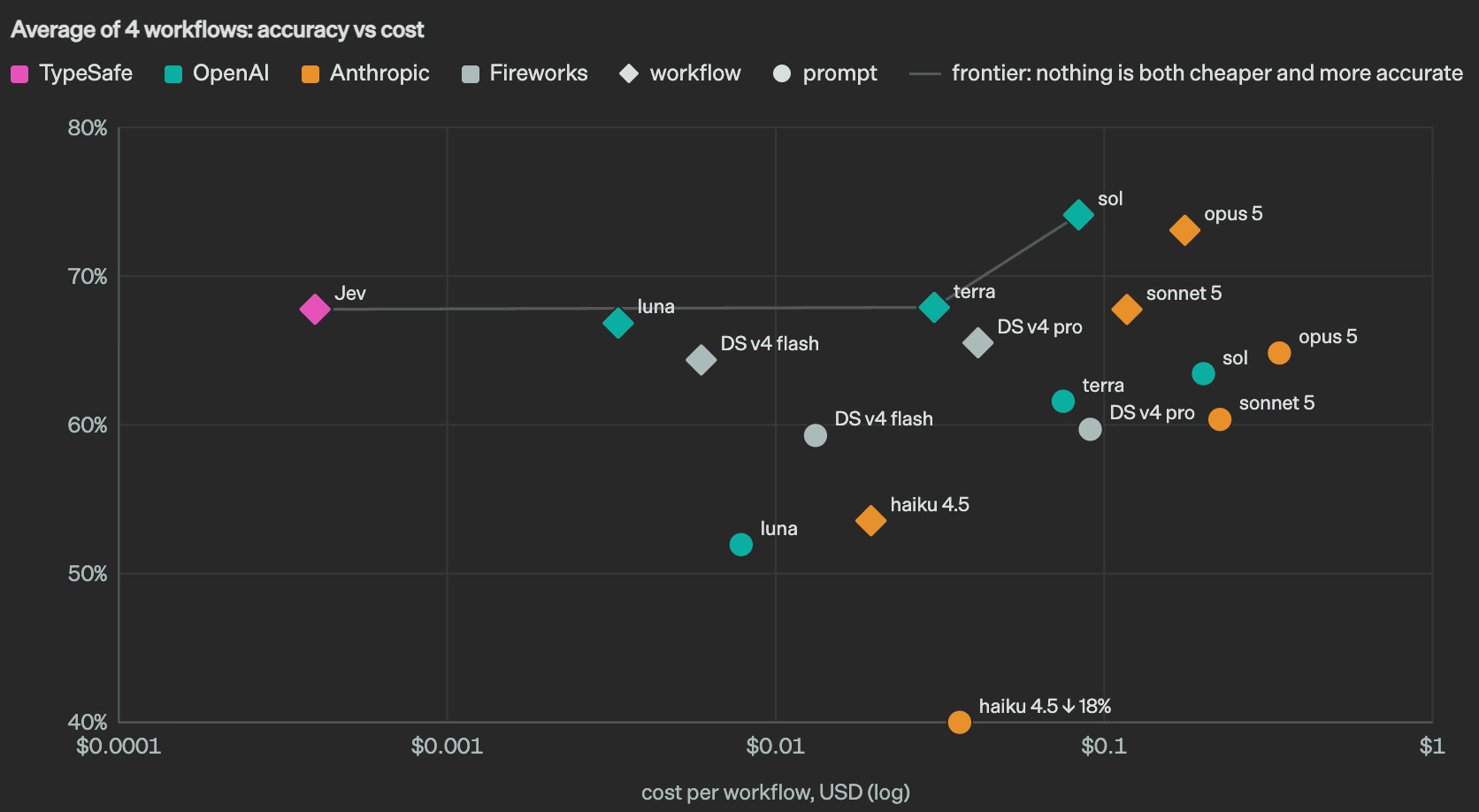
TypeSafe AI exits stealth with $40M to build AI for use by software
TypeSafe AI Inc., a startup founded by a former OpenAI Group PBC researcher who helped develop ChatGPT, emerged yesterday with $40 million in seed funding and a model designed to put artificial intelligence directly inside software applications. The San Francisco-based company says its first model, called Jev, differs from conventional large language models by producing […] The post TypeSafe AI exits stealth with $40M to build AI for use by software appeared first on SiliconANGLE .
SiliconANGLE